

Picture this. It’s a Wednesday afternoon, somewhere between 1 and 2 PM. You’ve just finished a shift, driven home with your sunglasses on, and finally fallen into bed around 9 AM. You wake up groggy, slightly disoriented, and vaguely guilty. Not because you didn’t sleep long enough, but because the gym bag sitting by the front door has been there, untouched, for eleven days.
You’ve read all the advice about exercise and night shift. Work out, they say. Stay consistent, they say. Your health depends on it, they say. What nobody says is when. Or why pushing too hard at the wrong time can sabotage the sleep you’ve already barely got. Or that the standard fitness world, with its 6 AM bootcamps and post-work gym sessions, was not designed with you even remotely in mind.
Exercising on night shift is one of the most misunderstood challenges in the overnight worker’s life. Not because it’s impossible. It isn’t. But because the rules are genuinely different for people whose body clock has been turned inside out, and most fitness advice doesn’t acknowledge that those different rules exist.
Here’s what the research actually says, including some findings that will surprise you.
Why Exercising on Night Shift Is a Different Problem Entirely
Why is it so hard to exercise consistently on night shift?
Not because you’re lazy. That needs to be said plainly, because it’s the silent accusation hanging over every night worker who lets the gym membership go unused for a month. The difficulty is structural and biological, not motivational.
A 2025 Scientific Reports study that specifically examined exercise and sleep in night shift healthcare workers identified the core tension precisely: the same exercise that helps day workers sleep better can actively make sleep worse for night workers if the timing or intensity is wrong. The study, a randomized crossover trial conducted across six hospitals in Taiwan, compared moderate-intensity continuous exercise and high-intensity interval training in night shift workers with mild sleep impairment. The results drew a clean line between what helps and what hurts, and the distinction isn’t intuitive.
Beyond timing, there’s the energy problem. Your circadian rhythm governs not just when you feel sleepy but when your muscles are physiologically primed for performance. Muscle strength, reaction time, cardiovascular efficiency, and hormonal support for training all follow a circadian pattern that peaks in the late afternoon for the general population. That window, roughly 4 to 7 PM, is when most of the population exercises. For night workers, that’s either deep in your sleep window or right before you head into a twelve-hour shift. Neither is ideal.
A 2024 landmark perspective published in Communications Biology by researchers at CQ University’s Appleton Institute proposed something the fitness world has largely ignored: that for shift workers, exercise isn’t just a health intervention. Timed strategically, it’s a circadian adaptation tool, one of the few non-pharmaceutical countermeasures that can genuinely improve how your body adapts to night work across three distinct timeframes: within a single shift, across a block of shifts, and over the entire span of a shift working career. That reframes the entire question. Exercising on night shift isn’t just about staying fit. Done right, it can actively help your body cope with the schedule it’s on.
The Four Hours Rule That Changes Everything
Does exercising before bed affect sleep for night shift workers?
This is the question at the center of everything, and the answer comes from the largest study ever conducted on exercise timing and sleep. A 2025 Nature Communications study from Monash University analyzed data from 14,689 physically active individuals monitored over a full year, producing more than four million nights of objective sleep and exercise data tracked through wearable biometric devices. It’s the kind of dataset that cuts through the noise of smaller studies and delivers something close to a definitive answer.
What it found was a clear dose-response relationship. Later exercise timing and higher exercise intensity together predicted delayed sleep onset, shorter total sleep, lower sleep quality, higher resting heart rate during sleep, and reduced heart rate variability. All markers of compromised recovery. Critically, exercise that finished four or more hours before sleep onset showed no measurable negative impact on sleep quality regardless of intensity. The disruption was directly tied to how close to sleep the workout landed.
For night shift workers, this four-hour buffer is the architectural principle everything else builds on. If you’re sleeping from 9 AM to 5 PM after a night shift, any workout finishing after 5 AM is cutting into that buffer. Which means the common instinct to squeeze in a gym session immediately after your shift, while it feels efficient, is almost certainly costing you sleep quality in ways that compound across a working week.
This doesn’t mean post-shift exercise is always wrong. It means the type and intensity matter enormously, and the timing needs to respect that four-hour gap between finishing and your head hitting the pillow.

Intensity Is the Variable Nobody Talks About
What type of exercise is best for night shift workers?
The Taiwan RCT published in Scientific Reports in July 2025 provides the most directly applicable answer to this question for overnight workers. The study tested moderate-intensity continuous exercise at 70 to 75% of maximum heart rate against high-intensity interval training at 90 to 95%, both performed fourteen hours before a night shift. The contrast in outcomes was significant.
Moderate-intensity exercise produced measurable improvements in subjective sleep quality, earlier bedtime, and greater total sleep time compared to the control group who did nothing. The participants slept better and got more of it. High-intensity interval training produced the opposite: disrupted sleep quality compared to controls, not improved.
The mechanism behind this split sits in your autonomic nervous system. High-intensity exercise elevates sympathetic nervous system activity, the fight-or-flight arm of your autonomic system, for several hours after the session ends. Heart rate stays elevated. Core body temperature remains higher than the sleep-optimized baseline your circadian rhythm is trying to achieve. Adrenaline and cortisol remain in circulation longer. For day workers with a long buffer between their workout and bedtime, this elevation dissipates before sleep. For night shift workers already navigating a compressed sleep window, it doesn’t.
Moderate-intensity exercise, by contrast, generates the metabolic and cardiovascular benefits of physical activity while allowing the parasympathetic nervous system, your rest-and-digest mode, to reassert itself more quickly. You get the health gains without the sleep disruption.
MD Anderson’s exercise physiology team makes a related point specifically about high-intensity training and circadian disruption: vigorous exercise can delay melatonin production the following night after just a single session. For night workers whose melatonin timing is already fighting a losing battle against daylight, that additional delay is a genuine problem.
The takeaway isn’t that night workers shouldn’t do high-intensity training. It’s that intensity needs to be timed more carefully than it does for the general population, and moderate exercise closer to your sleep window is the safer default.
The Best Times to Exercise on Night Shift
When should night shift workers exercise?
There isn’t one universal answer here, because it depends on your specific schedule, how consistently you work nights, and whether you’re trying to protect sleep or actively use exercise to shift your circadian phase. But there are clear windows that consistently produce better outcomes.
Before Your Shift: The Strongest Option for Most Workers
Research consistently positions pre-shift exercise as the most reliable option for permanent night workers. If you wake at 5 PM before a 7 PM start, working out between 5 and 6 PM gives you the physiological benefits of exercise, including the temporary boost in alertness and cognitive function that carries into the early part of your shift, while placing the workout at a point in your personal circadian day that mirrors late afternoon for day workers. That’s when muscle performance is near its peak relative to your shifted clock.
NPR’s 2024 science reporting on exercise timing and circadian rhythms notes that the circadian muscle clock is exquisitely responsive to exercise and can be trained to align performance peaks with when you regularly work out. If you consistently exercise before your shift at roughly the same time, your muscle clock adapts. The workout gets better. Recovery becomes more efficient. Your body starts expecting and preparing for that physical demand at that specific time.
The pre-shift window also means you’re not fighting the four-hour buffer issue at all. You’re exercising comfortably outside of your sleep window.
The First Half of Your Shift: Movement as a Within-Shift Intervention
This one surprises people. Exercise during your shift, specifically light to moderate movement in the first several hours, is supported by the Communications Biology perspective on physical activity and shift work adaptation as a meaningful tool for maintaining alertness and cognitive performance during the hours when your circadian system is pushing hard against wakefulness.
The research points to a specific protocol: three minutes of walking every thirty minutes throughout the shift. Not a workout. A deliberate, consistent interruption of sedentary periods with low-intensity movement. A 2024 randomized controlled trial in Ergonomics tested this exact protocol across five simulated night shifts and found that participants who broke up sitting with regular walking showed significant reductions in fatigue and sleepiness compared to those who remained sedentary throughout. The effect was particularly strong for workers with more flexible chronotypes.
Three minutes every thirty minutes doesn’t feel like exercise. It doesn’t need to. It’s a physiological reset, generating just enough thermogenesis and circulation to counteract the alertness dip that builds with prolonged stillness at 3 AM.
Post-Shift: Proceed with Real Caution
Exercising immediately after your shift and then trying to sleep is where most night workers run into trouble. The adrenaline and elevated core temperature from any meaningful workout directly conflict with the sleep onset process. If post-shift exercise is your only realistic option because of childcare, partner schedules, or commute time, keep the intensity low. Walking, light stretching, yoga. Anything that moves your body without spiking your sympathetic nervous system. Finish at least four hours before your intended sleep time if you can manage it. If you can’t, a short gentle walk is better than nothing but accept that it may cost you fifteen to twenty minutes of sleep onset time.
Exercise as a Circadian Tool: The Bigger Picture
Can exercise help night shift workers adapt to their schedule?
This is where the conversation gets genuinely interesting and where most fitness advice for shift workers falls short by staying too narrow.
The Communications Biology research from the Appleton Institute proposes that timed physical activity can influence circadian adaptation across three timeframes simultaneously. Within a single shift, consistent light movement supports alertness and mood. Across a block of shifts, regular exercise timed to the same point in your circadian day strengthens the circadian signal your body receives, helping peripheral clocks in muscle, liver, and gut tissues align with your new schedule. Over the entire span of a shift working career, consistent exercise may build resilience against the metabolic and cardiovascular risks that accumulate with years on nights.
PMC research on circadian rhythm phase shifting through exercise found that the timing of exercise can genuinely shift the phase of your internal clock, much like light exposure, by influencing melatonin onset timing. For night shift workers specifically, consistently exercising at the same clock time each day sends a zeitgeber, a time-giving signal, to your circadian system. The body begins to use that repeated stimulus as an anchor for its biological rhythms. It’s not as powerful as light, but it’s a real, non-pharmaceutical circadian input that compounds over weeks and months.
This matters practically because it means exercising on night shift shouldn’t be thought of purely as fitness maintenance under difficult conditions. At its best, a well-timed, consistent exercise routine is one of the tools that helps your body manage a schedule it wasn’t designed for.
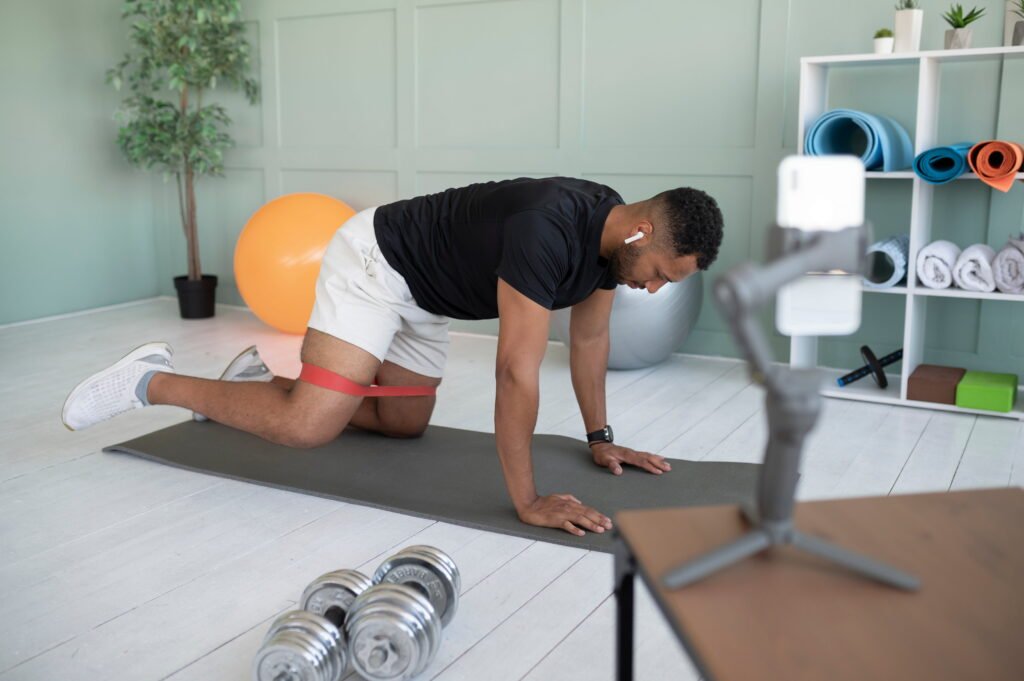
What Exercise Types Work Best
What workouts are most practical for night shift workers?
Given everything the research tells us about intensity, timing, and the four-hour buffer, here’s how different exercise types stack up for the overnight schedule.
Moderate-intensity cardio, running at a conversational pace, cycling, swimming, brisk walking, is the most consistently supported option for night workers. It delivers the cardiovascular and metabolic benefits of training, supports sleep rather than disrupting it when timed correctly, and can be done before a shift without significantly elevating core temperature for hours afterward.
Strength training at moderate intensity works well in the pre-shift window. Keep rest periods adequate, avoid training to failure close to your sleep window, and allow forty-eight hours of recovery between sessions targeting the same muscle groups. The hormonal response to resistance training, particularly the cortisol release, is more prolonged than steady-state cardio and needs that buffer more, not less.
Yoga and mobility work are genuinely useful for the post-shift or pre-sleep window specifically because they activate the parasympathetic nervous system rather than the sympathetic one. A Frontiers in Psychology systematic review and meta-analysis on exercise and sleep quality found yoga produced some of the strongest effects on sleep quality across exercise types, with large effect sizes in several analyses. If you need to move your body in the hours immediately before sleep, this is the category that won’t cost you.
High-intensity interval training, CrossFit-style workouts, and heavy lifting close to your sleep window are where night workers consistently get burned. The Nature Communications four-million-night study found that strenuous workouts within two hours of bedtime delayed sleep onset by an average of 36 minutes. When the workout happened after the usual sleep time, that delay more than doubled to 80 minutes. For someone with a six or seven-hour sleep window before the next shift, those delays aren’t trivial.
Building a Routine That Survives Real Life
How do night shift workers stay consistent with exercise?
Consistency beats optimization every single time. The perfect workout at the biologically ideal moment that you do twice and abandon is infinitely less valuable than a manageable routine you maintain for six months. A few principles that actually stick for night workers.
Anchor your workouts to your schedule, not a clock time. Instead of “I exercise at 5 PM,” make it “I exercise after I wake up and before I eat.” That way the routine survives when your shift pattern changes, because the workout is tied to a personal behavioral cue rather than an external clock that doesn’t care what you did all night.
Give yourself permission to count movement at work. If you’re a nurse who walked five miles during your shift, broke up sitting with regular movement, and spent eight hours on your feet, that is physical activity. It doesn’t have the structured cardiovascular benefits of a dedicated workout, but treating it as zero because it wasn’t done in gym clothes is counterproductive.
Two dedicated sessions per week is a sustainable minimum. Not glamorous advice. But two consistent sessions per week, maintained over six months, produces real fitness outcomes and doesn’t grind down your already limited recovery capacity the way five-days-a-week programming does for someone sleeping four to six hours a night.
Track your sleep response when you try new workout timings. What works for one night worker’s biology won’t work for another. The four-hour buffer is the universal rule. Everything else, whether you do better exercising at the start of your wake window or closer to your shift, how much intensity you can handle before sleep degrades, is personal. Pay attention. Your own data is more useful than any generalized protocol.

The Permission Slip Most Night Workers Need
Here’s what this comes down to. Exercising on night shift is harder than exercising on a conventional schedule. The timing constraints are real. The energy deficits are real. The way the fitness world ignores your schedule entirely when dispensing advice is a genuine failure, not your personal shortcoming.
But the research, increasingly specific and increasingly rigorous on this exact question, offers something more useful than either “just push through” or “give up until your schedule changes.” It offers a framework. Moderate intensity. Pre-shift or during-shift timing. A four-hour buffer before sleep. Consistent light movement throughout overnight hours. Yoga or gentle stretching in the sleep-adjacent window.
That framework won’t make exercising on night shift easy. Nothing does. But it makes it possible without the cost you’re currently paying every time a hard workout at the wrong moment turns your next sleep into four fragmented hours that leave you worse off than if you hadn’t bothered.
Your body is worth the effort of figuring this out. Start with one walk before your next shift. Just one. The research says it counts more than you think.
Join the Nightshifters Community | Request a specific night shift guidance
When do you exercise on nights, and has any timing or approach actually worked for you? Or has it felt impossible to maintain no matter what you try? Drop it in the comments. This is exactly the kind of conversation the night shift community needs more of.