
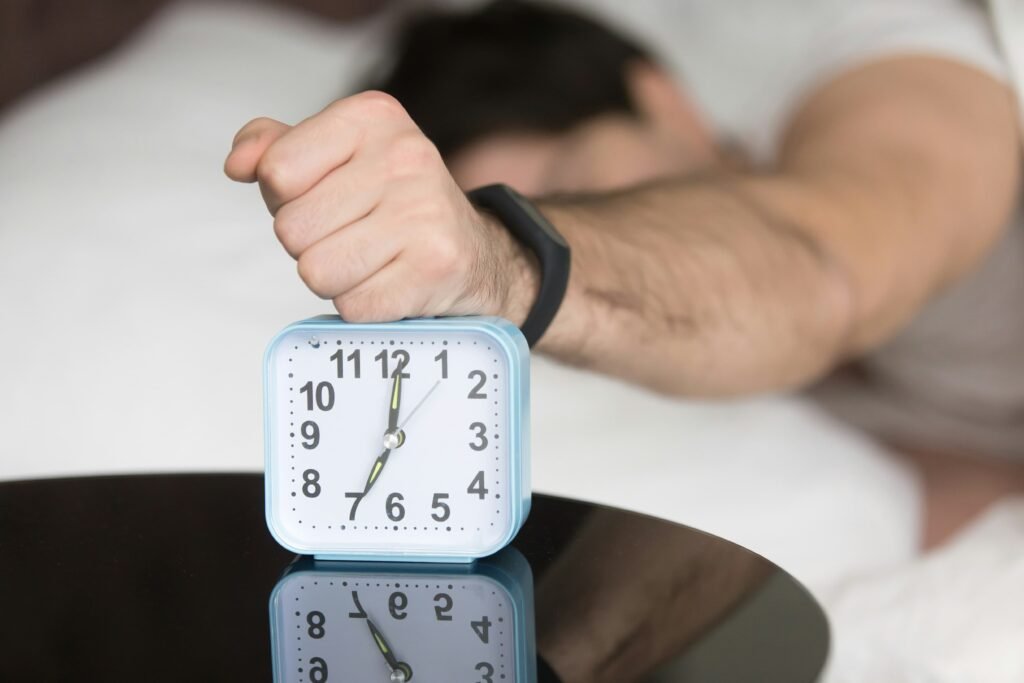
Three weeks of nights. That’s what your new schedule says. You’re wondering if your body will ever adjust, or if you’ll spend the next month feeling like you’ve been hit by a truck.
Here’s what science says: your body will start adjusting in about 10 days. Full adaptation? That might take as long as three years or might never happen at all.
And here’s the complication: most shift workers don’t stay on nights indefinitely. You rotate between days and nights, have days off where you flip back to normal, or work a block of nights before switching to days. Every time you switch, you start over.
The reality? True adjustment to night shift is rare because most schedules don’t allow it. You’re not adjusting; you’re managing constant transitions. You really want to adjust to night shift?
The Hard Truth About Circadian Adaptation
Your body runs on a 24-hour internal clock called the circadian rhythm. Located in your brain’s suprachiasmatic nucleus, this clock controls when you feel alert or sleepy, your body temperature, hormone production, and metabolism.
This system evolved over millions of years to keep you awake during daylight and asleep at night. Light is the primary signal. When your eyes detect bright light, your brain suppresses melatonin (the sleep hormone). When it gets dark, melatonin ramps up, making you drowsy.
Night shift forces you to fight this entire system.
The problem: your circadian clock can only shift by about one hour per day. To completely reverse your rhythm from day to night requires a 12-hour shift. Even if you work seven night shifts in a row, your clock will only shift 5-6 hours—less than halfway.
Some workers on extended schedules adapt more fully. Oil rig workers or miners doing 14 consecutive nights can achieve near-complete adaptation by the end. Then they flip back on time off.
For most shift workers who rotate or have regular days off, complete adaptation isn’t possible. Your schedule doesn’t stay consistent long enough.
What “Adjusting” Actually Means
When people ask “how long to adjust to night shift,” they mean “when will I stop feeling awful?” That’s different from “when will my circadian rhythm flip?”
Adjustment happens on multiple levels:
Physical: Your body learns to function on the new schedule. Daytime sleep gets easier, staying awake at night feels less brutal, exhaustion lifts.
Mental: You develop coping strategies, anxiety decreases, confidence handling night work improves.
Social: You figure out how to maintain relationships despite opposite schedules. You learn to say no to daytime commitments without guilt.
Practical: You establish working routines. Sleep environment is optimized, meal timing figured out, you know what helps you function.
These don’t all happen at once, and timelines vary.
The Adjustment Timeline

Week 1: The Shock Phase
Your first week is usually the hardest. Your body has no idea what’s happening.
What you’ll experience:
- Extreme fatigue during shifts
- Difficulty falling asleep during the day (body temperature rises as morning progresses)
- Sleeping only 4-5 hours despite exhaustion
- Disorientation and fog
- Digestive issues, mood swings, irritability
Why: Your circadian rhythm hasn’t shifted at all. Melatonin still releases at night when you’re working. Body temperature still rises during the day when you’re trying to sleep.
What helps:
- Blackout curtains or eye masks
- White noise for daytime sounds
- Light meals before shifts
- Strategic caffeine (first half of shift only)
Weeks 2-4: Initial Adaptation
Around day 10, most people notice small improvements. Your body begins initial adaptation.
What you’ll experience:
- Slightly easier to fall asleep during the day
- Can sometimes get 6 hours of daytime sleep
- Still exhausted, but not as bone-deep
- Starting to develop coping strategies
- Less disorientation
Why: Your circadian clock has shifted 2-3 hours. You’re still misaligned, but less severely. Your body is building tolerance.
What helps:
- Consistency: Same bedtime daily, even days off (within 1-2 hour window)
- Bright light during first hours of work
- Sunglasses during morning commute home
- 90-minute pre-shift nap for improved alertness
Months 2-3: Finding Your Rhythm
If you’re working longer night blocks (4-6 weeks or more), you reach what researchers call a “compromise circadian phase position”. Not fully adapted, but a manageable middle ground.
What you’ll experience:
- More reliable daytime sleep (6-7 hours most days)
- Night shifts feel less brutal
- Routines that work for your schedule
- Social life still challenging, but expectations adjusted
- Physical symptoms may have improved
Why: Your clock has shifted 4-6 hours. You’re neither fully nocturnal nor diurnal. This partial realignment significantly improves mood, fatigue, and performance.
The catch: This only applies if you’re on nights long enough. Rotate every 2-3 weeks? You’ll hit initial adaptation right before switching schedules.
What helps:
- Maintain overlapping sleep hours on days off
- Bright light at work, darkness at home
- Pre-shift routines that signal your body
Long-Term: The Reality
For most shift workers, there’s no “long-term adjustment” because schedules keep changing.
Extended night blocks (several months):
- Maximum adaptation after 3-6 months
- Good days and bad days, but fewer awful days
- Established coping mechanisms
Rotating shifts (most workers):
- Never reach full adaptation to either schedule
- Constantly in transition mode
- Goal shifts from “adjusting” to “managing transitions”
Even workers on nights for months find their circadian rhythms never fully flip. Your biology still pulls toward sleeping at night.
The Rotating Shift Reality

Most shift workers rotate between days and nights. This is the norm, not the exception.
Every time you switch, you reset whatever progress you’d made. Studies show rotating shifts cause more anxiety and cognitive problems than consistent schedules. You’re in perpetual jet lag.
Weekly rotations (7 nights, 7 days):
- Clock starts shifting, then you switch
- Never reach even partial adaptation
- Exhaustion compounds
Monthly rotations (4 weeks nights, 4 weeks days):
- Might reach initial adaptation before switching
- Transition weeks are brutal each time
- Slightly better than weekly, but still hard
What helps:
- Don’t try to fully adapt to either schedule
- Strategic napping before each shift type
- Focus on adequate sleep, even if timing varies
- Manage transitions gradually, not abruptly
- Accept you’re managing transitions, not achieving adaptation
Individual Factors
Not everyone adjusts at the same pace. Factors that influence adaptation:
Age: Younger workers (under 30) adapt faster. Circadian rhythms become more rigid with age.
Chronotype: Night owls adapt significantly better than morning larks. If you naturally stay up late, night shift is easier.
Sleep debt: Already sleep-deprived when starting? Adjustment takes longer.
Light exposure control: Wearing sunglasses on morning commutes and using bright lights at work speeds adaptation.
Consistency: More consistent schedules = better adaptation. Frequent rotation prevents settling into any rhythm.
Overall health: Existing conditions, poor nutrition, or sedentary lifestyles make adaptation harder.
Speed Up Adjustment
You can’t force your circadian clock to flip overnight, but you can support faster adaptation.
Optimize Light Exposure
During night shifts:
- Bright light in the first half of your shift
- Avoid bright light in the second half
After shifts:
- Dark sunglasses during morning commute
- Completely dark bedroom (blackout curtains, tape over LEDs)
On days off:
- Bright light in afternoon (2-6 PM)
- Maintains middle-ground circadian position
Master Your Sleep Schedule

Extended night blocks (4+ weeks):
- Maintain overlapping sleep hours between work and off days
- Example: Sleep 8 AM-4 PM after nights, 3 AM-11 AM on days off
- The 8 AM-11 AM overlap provides stability
Rotating workers (most people):
- Transition gradually (shift bedtime 1-2 hours per day)
- Prioritize adequate sleep over perfect timing
- Strategic napping covers sleep debt
- Accept variable sleep schedules
Use Strategic Napping
Pre-shift naps are game-changers. A 90-minute nap 2-3 hours before your shift completes a full sleep cycle and significantly improves alertness.
Time Your Meals
Your metabolism follows circadian rhythms too.
- Eat main meals during your wake period (even if nighttime)
- Avoid heavy meals right before sleep
- Keep meal timing consistent
When It’s Not Working
Some people struggle more with night shift adaptation. Warning signs:
- Sleep issues persisting beyond first month (consistently under 6 hours)
- Increasing anxiety or depression
- Physical health problems (frequent illness, digestive issues, weight gain)
- Inability to function safely at work
- Relationship problems due to exhaustion and mood
If these persist beyond initial adjustment:
- Talk to your supervisor about schedule modifications
- See a doctor about Shift Work Sleep Disorder
- Evaluate if night shift is sustainable long-term
Not everyone can adapt. That’s biology, not weakness. Some circadian rhythms are too rigid, some chronotypes too morning-oriented.
The Bottom Line

How long does it take to adjust to night shift? The honest answer depends on your schedule.
Initial physical adjustment: 10-14 days
Functional adaptation (extended blocks): 2-3 months
Maximum adaptation (rare): 3-6 months for continuous nights
Full circadian reversal: Almost never happens
For rotating workers (most people): You don’t fully adjust. You’re constantly managing transitions. The goal isn’t adaptation; it’s learning to manage changes without destroying your health.
The reality: true adjustment is rare. Your schedule changes before your body catches up. What you’re learning isn’t how to adjust; it’s how to function despite never being fully adjusted.
Be patient with yourself during the first month. It’s genuinely hard. Use every tool: light exposure, sleep optimization, strategic napping, consistent routines.
Your body wasn’t designed for this schedule. Making it work anyway? That takes effort.
Get Support for Your Night Shift Journey
Adjusting to night shift is challenging, but you don’t have to figure it out alone. Join our community where thousands of shift workers share strategies, support each other through transitions, and celebrate victories.
Join the Community | Get Personalized Guidance
Questions about adjusting to night shift? Drop them in the comments. We respond to every question because the transition is real, and you deserve support.