
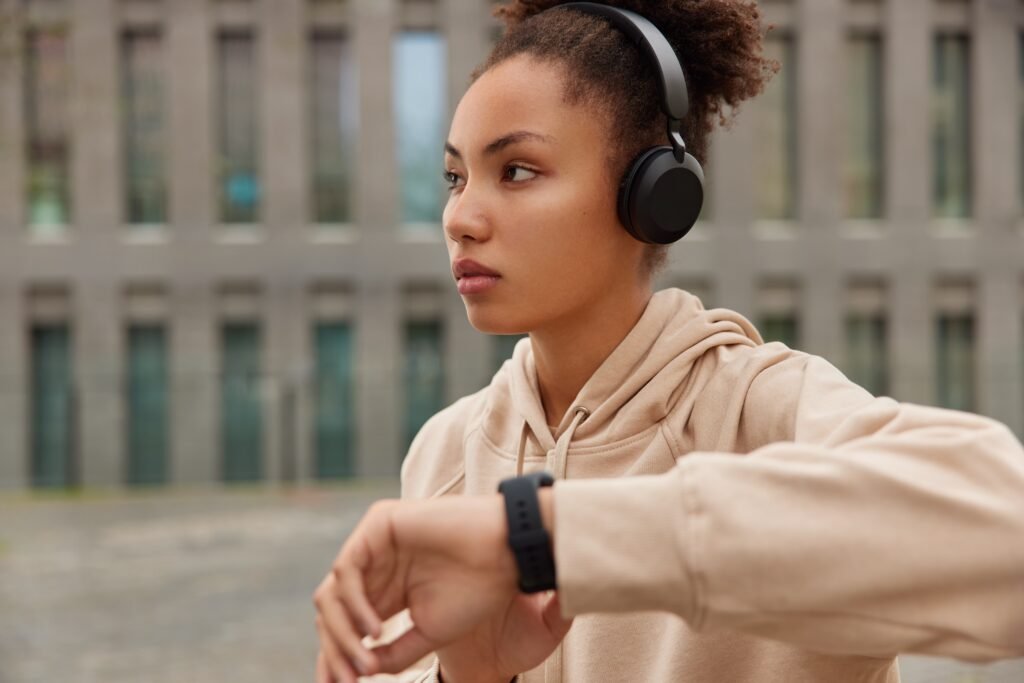
Every fitness tracker ships with the same assumption baked into its software. It assumes you sleep at night. It assumes your most demanding hours are during the day. It assumes you want to be productive between 9 AM and 5 PM and recovered by 10 PM. The charts are built around it. The recovery scores are calculated against it. The sleep stage diagrams show midnight to 7 AM as the expected window, your eight-hour target sitting neatly in the dark hours like it was always supposed to.
For night shift workers, almost none of that is useful in its default form. Most workers either abandon the device within a few months because the data makes no sense, or they keep wearing it and interpret everything through the wrong lens. Either way, the device is not helping.
Night shift and wearables can be genuinely powerful together. But only if the worker understands what the device is actually measuring, what it cannot, and how to reframe the data for an inverted schedule.
Why Most Wearable Data Is Misleading for Night Shift Workers
The night shift and wearables problem starts with how consumer devices calculate their core metrics. Recovery scores, readiness scores, and strain assessments are all built on population-level baselines calibrated to circadian rhythms aligned with daylight. When an Oura Ring or a Whoop band calculates your recovery, it is comparing your overnight physiological data against a model that assumes you were asleep during those hours in the first place.
A night shift worker wearing an Oura Ring through a twelve-hour shift will generate data the device interprets as a prolonged awake period with elevated heart rate and reduced HRV. The daytime sleep that follows may be partially misclassified or scored against an incorrect baseline entirely. A 2024 validation study at Brigham and Women’s Hospital found that the Oura Ring Gen3 achieved 76 to 79.5 percent sensitivity across sleep stages compared to polysomnography, the clinical gold standard. That accuracy figure applies to nocturnal sleep under research conditions. A device classifying daytime sleep in a partially lit room, on a worker whose circadian system is actively resisting sleep, is operating significantly outside those conditions.
This does not mean the data is useless. It means it needs to be read differently. Night shift and wearables become a useful combination when the worker stops asking “what does the app say?” and starts asking “what pattern does the raw data actually show?”
What HRV Actually Tells Night Shift Workers
Heart rate variability is the metric that carries the most actionable information for night shift workers, and the one most consistently misinterpreted because the context for interpretation is wrong.
Higher HRV means your nervous system is genuinely recovering. Lower HRV means it is still running the overnight shift even after you clocked out. A 2025 systematic review and meta-analysis published in Frontiers in Neurology, examining HRV across 28 sleep deprivation studies, confirmed that sleep deprivation significantly reduces HRV, with the reduction reflecting autonomic nervous system dysregulation and constituting a plausible cardiovascular disease pathway.
For night shift workers, the HRV pattern is specific. A 2025 prospective observational study published in BMC Nursing, measuring HRV in 35 female nurses before and after night shifts, found that pre-shift total sleep time and post-shift daytime recovery sleep quality were the two primary predictors of parasympathetic HRV recovery. Sleep better before the shift and after it, and your HRV recovers. Compromise either, and the autonomic cost compounds.
A consistently low HRV during daytime sleep, even if the device reports adequate sleep duration, is a signal that the recovery is not happening even when the hours are present.
That single insight changes how to use a wearable on a night shift schedule. Duration is not the metric to optimize. Recovery quality is. An EMT shift worker study confirmed that workers showed significantly reduced vagal HRV during work days compared to rest days, with blood pressure remaining elevated for more than 12 hours post-shift due to sympathovagal imbalance. The implication: HRV measured in the hours immediately after a shift, even before sleep begins, tells you something about the autonomic cost of that specific shift that post-sleep readings alone cannot capture.
How to Set Up Your Wearable for a Night Shift Schedule
The most important technical adjustment is resetting the device’s sleep window to reflect when you actually sleep, not when the algorithm expects you to. Most major devices allow this manually, and most night shift workers have never done it.
On the Oura Ring, this is done through the app’s Sleep settings where you can set a manual sleep window defining your expected sleep period. Setting this to your actual daytime window, say 8 AM to 4 PM, tells the ring to score your sleep against a model aligned with that window rather than assuming 11 PM to 7 AM. Research on circadian rhythm monitoring in 2026 confirms that devices combining light exposure data with activity and skin temperature provide the most accurate circadian phase assessment available to consumers, with blue light in the 460 to 490 nanometer range being the strongest circadian regulator the sensor data captures.
On Whoop, strain and recovery calculations can be recalibrated by adjusting your sleep logging to reflect actual sleep timing. Whoop’s HRV baseline is a rolling 30-day average, which means it naturally adapts to your physiology over time if you wear it consistently and log sleep accurately. This rolling adaptation is one of Whoop’s genuine advantages for workers on irregular schedules.
Garmin devices offer a Training Status and Recovery Time metric that updates per 24-hour cycle rather than per calendar day, making them more adaptable to non-standard schedules when sleep and activity settings are adjusted correctly. The default settings on every major device assume a standard schedule. Using a wearable on a night shift schedule without changing those settings produces systematically misleading scores. This is the first thing to fix, before interpreting a single number.
What Night Shift and Wearables Data Can Actually Reveal About Your Sleep
The most valuable application of night shift and wearables is not the readiness score or the step count. It is the longitudinal sleep pattern that becomes visible after four to six weeks of consistent wearing.
Night shift workers using wearables consistently discover specific environmental disruptions to their daytime sleep that they had normalized and were no longer consciously registering. A 2026 case study documented a night shift nurse who switched to an Oura Ring Gen 4, manually set her sleep window to 8 AM to 4 PM, and within two weeks the ring flagged that her deep sleep was consistently below one hour despite reporting six or more hours in bed. Cross-referencing her light log, she found her bedroom was not dark enough due to streetlights and digital clock displays, and that her 5:30 AM coffee was blunting melatonin clearance and delaying circadian realignment. She installed blackout shades, delayed caffeine, and shifted her carbohydrate intake to her active window. In ten weeks her deep sleep recovered, her fasting glucose dropped, and her average HRV increased by 18 milliseconds.
The wearable did not solve the problem. It made the problem visible.
Sleep stage trends over weeks reveal whether N3 deep sleep is chronically suppressed, which explains why so many night shift workers feel physically unrepaired and mentally foggy even after what the device reports as adequate sleep. For a detailed breakdown of what to do once a sleep problem is identified, the guide to how to fall asleep after night shift covers the evidence-based protocol and the guide to how to wind down after night shift addresses the pre-sleep cortisol management that wearable data frequently identifies as the root of the problem.
How Wearables Help Night Shift Workers Track Circadian Alignment
The cutting edge of night shift and wearables in 2026 is using light exposure data alongside HRV and sleep staging to assess circadian alignment directly rather than inferring it from how terrible you feel.
Research published in 2026 examining circadian rhythm monitoring with wearables confirmed that devices combining blue light specificity with high-accuracy skin temperature sensors provide the most robust circadian phase assessment available to consumers. Most night shift workers do not need research-grade equipment to access this data. The skin temperature sensor available on the Oura Ring and newer Garmin and Whoop models does it already.
Your core body temperature follows a circadian pattern, falling during biological night and rising toward biological morning. Tracking this over weeks reveals whether your circadian phase is partially adapting to your schedule or still strongly opposed to it. A night shift worker whose skin temperature minimum is gradually shifting toward the middle of their sleep window is showing circadian adaptation. One whose temperature minimum stays stubbornly aligned with 4 to 6 AM regardless of sleep timing is showing minimal adaptation, which predicts greater fatigue, higher cardiovascular risk, and poorer cognitive performance across shifts.
This data is available on most premium wearables right now. Almost no night shift worker is using it. That gap between available information and applied action is where night shift and wearables have the most untapped potential.
Which Wearables Actually Work for Night Shift Workers in 2026
Not all wearables handle an inverted schedule equally. Three devices consistently lead for night shift use cases, each with different strengths.
The Oura Ring Gen 4 remains the strongest option for sleep staging accuracy in daytime sleep contexts. The Brigham and Women’s Hospital validation study found the Oura Ring Gen3 demonstrated the highest four-stage sleep staging accuracy among consumer wearables tested against polysomnography. The ring form factor is also the most comfortable for daytime sleep, avoiding the wrist restriction that disrupts some workers during their sleep window. Its skin temperature sensor provides the circadian temperature tracking described above. The limitation is that the sleep window requires manual adjustment and the default algorithm still skews toward nocturnal assumptions until that adjustment is made.
Whoop 5.0 is the strongest option for HRV monitoring and strain-to-recovery ratio tracking across a working week. Its 30-day rolling HRV baseline adapts to the individual worker’s physiology rather than a population average, making it more sensitive to week-on-week changes in autonomic recovery. Whoop demonstrated stronger agreement with gold-standard measurements for HRV than most competitors in independent evaluations. The limitation is that recovery scoring still uses time-of-day assumptions requiring manual correction for inverted schedules.
Garmin devices, particularly the Fenix series and Epix Pro, offer the most comprehensive circadian phase tracking through their Body Battery metric, which integrates HRV, stress, sleep, and activity data across a full 24-hour cycle rather than resetting at midnight. This makes Garmin the most schedule-agnostic of the three for workers whose shifts rotate between runs. The trade-off is that sleep staging accuracy is generally lower than Oura in head-to-head comparisons.
How to Actually Use Your Wearable to Improve Night Shift Health
Night shift and wearables produce the best health outcomes when the worker has a specific question they are using the device to answer, not when they are checking a score each morning and reacting to a number that was calculated for someone else’s schedule.
The most productive questions for night shift wearable use are: Is my daytime sleep producing the HRV recovery that night sleep would? Is my deep sleep duration adequate or chronically suppressed? Is my circadian temperature minimum shifting toward my sleep window or staying opposed to it? What specific changes, in bedroom darkness, caffeine timing, or sleep window consistency, produce measurable HRV improvement in the days that follow?
For supplement strategies with measurable effects on HRV and sleep staging in night shift contexts, particularly magnesium glycinate which directly supports parasympathetic recovery through GABA receptor modulation, the complete evidence base is in the guide to the best supplements for night shift workers. For the alertness strategies that wearable data can help optimize by tracking which caffeine and nap timing approaches produce the best post-shift HRV, the guide to how to stay awake on night shift covers the full protocol.
The device does not fix the schedule. But it makes the schedule’s effects on your body visible in ways that allow you to intervene before the consequences become symptoms. The night shift worker who uses their wearable to track patterns rather than individual scores, and who adjusts their settings to reflect their actual life rather than the life the device assumes they have, ends up with a personalized health monitoring system that no standard health check is equipped to provide.
What has your wearable revealed about your night shift health that surprised you? Share it in the comments.