

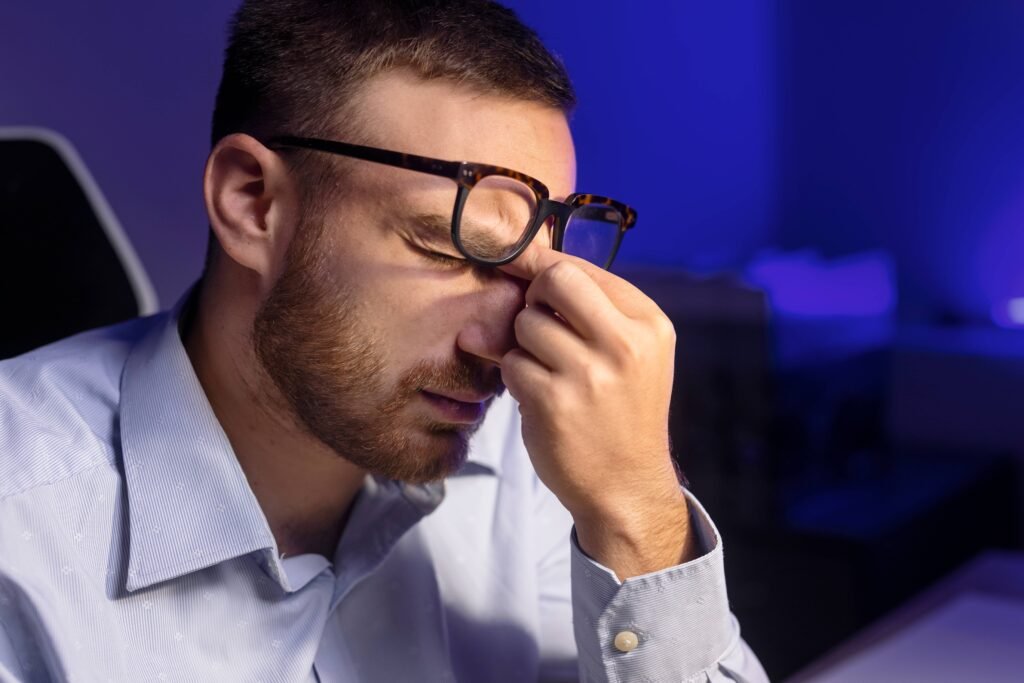
Somewhere around hour three, the eyes start registering a complaint. A dryness that artificial tears only partially fix. Text that was sharp four hours ago has softened at the edges. The headache sitting just behind the orbital bone that workers learn to work through. People who spend years on overnight schedules tend to call these symptoms part of the job, unavoidable background noise that comes with working under fluorescent light while the rest of the world sleeps. Most of them have never considered that the schedule is doing something specific to their visual system, something that goes beyond ordinary tiredness and involves mechanisms their optometrist has probably never asked about.
Night shift and eye health are connected through the circadian system’s relationship with the eye’s own internal clock, through the specific visual demands of overnight environments, and through what fatigue does to every function the eyes perform. Understanding those connections does not make overnight work easier. But symptoms that can be explained tend to have solutions, and most night shift workers with eye complaints have only ever been offered the generic ones.
What Does the Research Actually Show About Night Shift and Eye Health?
The most specific research on night shift and eye health published recently came from a 2024 Scientific Reports study using optical coherence tomography angiography, a high-resolution imaging technique that measures blood flow and vessel density in the retina and the choroid, the vascular layer sitting beneath it. The study compared 25 night shift medical workers with 25 non-night-shift controls and found significantly decreased choroidal vascularity index and choriocapillaris flow deficit in the night shift group, alongside significantly increased choroidal thickness. The researchers also measured six-sulfatoxymelatonin, the primary urinary melatonin metabolite, and found it was significantly lower in night shift workers, with that suppression positively correlated with the vascular changes they observed.
This is preliminary research, 50 participants, no established causal pathway from these findings to clinical harm. What makes it significant is that it is the first study to use OCT angiography to examine retinal and choroidal microvascular structure specifically in night shift workers, and the melatonin correlation is biologically plausible. The eye has its own peripheral circadian clock, separate from the brain’s master clock in the hypothalamus. The retina produces melatonin locally, and that local melatonin has an established neuroprotective role for photoreceptors. Night shift work suppresses both systemic and retinal melatonin. What the imaging finds in the vasculature is a downstream signal of that suppression.
A 2024 VSP Vision Care study of 82 percent of Gen Z workers who regularly work nights and weekends found that 54 percent of them reported declining eye health. Self-reported data rather than clinical measurement, but it confirms at scale what night shift workers describe anecdotally: the eyes change after sustained overnight work, and the workers experiencing it attribute it to the schedule.
What Night Shift Does to Eye Lubrication
Dry eye is the most immediately uncomfortable and most consistently reported night shift and eye health problem, and the mechanism is more specific than most workers realize.
Blinking is the eye’s primary lubrication system. Each blink distributes tear film across the ocular surface, prevents evaporation from the cornea, and stimulates the meibomian glands in the eyelids to release the oil layer that keeps tears stable between blinks. Screen work, which accounts for most of what overnight workers do during the quieter hours of a shift, reduces blinking by up to 66 percent compared with non-screen activities. That blink reduction happens on day shifts too. On night shifts it happens against a background of greater fatigue, lower tear production from sleep deprivation, and a biological environment that is already less suited to visual recovery.
A 2024 meta-analysis examining 103 studies and 66,577 participants found that computer vision syndrome, the cluster of symptoms including dry eyes, blurred vision, eye strain, and headache that results from prolonged screen use, affects 66 percent of screen users globally. Night shift workers are not simply experiencing the standard computer vision syndrome burden. They are experiencing it on top of a fatigue profile, a circadian disruption, and an artificial lighting environment that all compound the baseline risk in directions the general statistic does not capture.
Sleep deprivation is a driver that most discussions of dry eye in this population miss entirely. Adequate sleep is necessary for normal tear film production and meibomian gland function. Workers who consistently sleep fewer hours than they need, or whose daytime sleep is fragmented and non-restorative, produce less tear film and experience faster tear evaporation when they are awake. The guide to how to fall asleep after night shift covers the sleep protocol that directly determines how well the eyes recover between shifts.
How Night Shift Affects Visual Fatigue
A Journal of Clinical Sleep Medicine study examined ocular measures of sleepiness in night shift workers during a simulated overnight shift, tracking the relationship between the circadian melatonin rhythm and objective eye-based sleepiness indicators. The study found that slow eye movements, blink rate changes, and pupillary responses were all significantly elevated near the peak of the melatonin rhythm, which corresponds to the circadian nadir between 3 and 5 AM. The melatonin peak is when the eyes are physiologically most resistant to sustained visual work. Night shift workers do sustained visual work at this exact time on every shift they work.
Visual fatigue during overnight shifts shows up as blurred vision, difficulty holding focus, increased glare sensitivity, and a burning or heaviness in the eyes that worsens through the second half of the shift. These symptoms are functional impairments, not structural damage, and they recover with adequate rest. The problem is that rest after a night shift lands in the hours when the circadian system most actively resists sleep, producing a recovery period that is shorter, lighter, and less restorative than what the same duration of visual work earns for a day worker.
Artificial lighting is a separate compounding factor in overnight environments. Fluorescent lighting, which dominates many hospital, warehouse, and industrial settings, produces the highest glare load of common artificial light types and creates a contrast challenge that is especially pronounced when the world outside every window is dark. The eyes adapt to indoor light levels over a shift and then encounter morning sunlight on the commute home, a luminance increase of several orders of magnitude that a circadian-disrupted visual system handles significantly less efficiently than a rested one.
Blue Light and Night Shift Eye Health: What the Evidence Actually Says
This is the area where accuracy matters more than alarm, and where the popular understanding of blue light and eyes has moved well ahead of what the research currently confirms.
A 2026 PMC review of blue-light-filtering spectacle lenses examined the literature comprehensively and found that while prolonged screen exposure has been linked to digital eye strain, visual fatigue, potential retinal damage, and sleep disturbances, the efficacy of blue-light-filtering lenses in reducing these effects remains debated. The American Academy of Ophthalmology’s position, updated to 2026, is that there is no scientific evidence that light from computer screens damages the human retina. Animal models have demonstrated retinal damage from acute high-intensity blue light, but the doses in those experiments are substantially higher than anything a workplace screen produces.
What is established for night shift workers is more specific. Blue light at 460 to 490 nanometers is the most potent circadian signal available, suppressing melatonin production within minutes of exposure. The blue light that matters most for night shift and eye health is not the glow from a monitor during a shift. It is the morning sunlight and indoor lighting encountered on the commute home, which suppresses the melatonin needed for post-shift sleep quality, which in turn determines how completely the eyes recover before the next shift.
Blue-blocking glasses worn on the commute home address the circadian pathway with strong evidence behind them. Their direct eye protection benefit is more limited but not absent. The 2026 PMC review confirmed that blue-light-filtering lenses may reduce digital eye strain symptoms in some users, with the most consistent reported benefits being reduced glare sensitivity and improved visual comfort during prolonged screen use. For workers whose visual systems are already compromised by fatigue and circadian disruption, reduced glare sensitivity is a meaningful benefit even while the long-term retinal protection question sits unresolved.
What Night Shift Workers Can Actually Do for Their Eye Health
The night shift and eye health problem responds to interventions at every stage of the shift cycle. None of them require expensive equipment.
Use the 20-20-20 rule on a timer during overnight shifts
Every 20 minutes of screen work, look at something 20 feet away for 20 seconds. A 2023 contact lens study validated this rule’s effectiveness for dry eye symptoms and tear film stability. During overnight shifts when the external environment beyond windows is dark and screen work runs continuously, the environmental variety that naturally triggers visual breaks during daytime work does not exist. The trigger needs to be artificial. Set a phone timer or use a break reminder app. This is not a convenience; it is replacing a cue that the overnight environment removed.
Address dry eye through its actual causes, not just its symptoms
Artificial tears reduce discomfort. They do not address what is producing it. For night shift workers the more productive interventions are increasing conscious blink frequency during screen work, maintaining ambient humidity in the work environment where possible, staying consistently hydrated through the shift, and protecting the daytime sleep that determines tear film production. Dehydration reduces tear production directly and is consistently underestimated as a visual health factor on overnight shifts. A water bottle within reach during the shift is also an eye health tool, even if nobody has framed it that way before.
Manage light exposure at the transition points of the shift
The most important visual interventions for night shift and eye health happen at the shift’s beginning and end rather than during it. Reducing overhead glare through dimmer or warmer lighting during the second half of the overnight window eases visual fatigue before the commute home. Blue-blocking glasses on the commute home prevent the morning light exposure that simultaneously suppresses melatonin and forces the already-fatigued visual system through a rapid high-luminance adaptation. Full blackout in the bedroom during daytime sleep removes the luminance stimulation that fragments recovery sleep and compromises the ocular restoration the eyes need between shifts. The complete light management protocol is in the guide to light therapy for night shift workers.
Tell your optometrist the specifics of your schedule
A routine eye examination conducted during daytime hours on a day off does not capture what the eyes are doing during a twelve-hour overnight shift under fluorescent light while staring at a monitor. Telling your optometrist the hours you work, the screen intensity, the lighting environment, and which symptoms are worst at which point in the shift gives them information they cannot infer from a standard examination. Workers over 40 on overnight schedules have the added consideration that age-related changes in tear production and lens accommodation interact with both the dry eye burden the schedule creates and the near-focus demands of overnight screen work. Regular professional eye assessment becomes more important, not less, as the years on nights accumulate.
Night shift workers have spent years attributing visual symptoms to the job when those symptoms belong specifically to the hours. The dryness, the fatigue, the mid-shift blur, and the headache sitting behind the eye are the visual system’s response to a schedule it was not built to sustain without some deliberate support. Most of the support is cheap, practical, and available on the next shift. The research is clear enough to act on even where it is not yet complete.
What has made the biggest difference to your eye comfort on nights? Share it in the comments.