
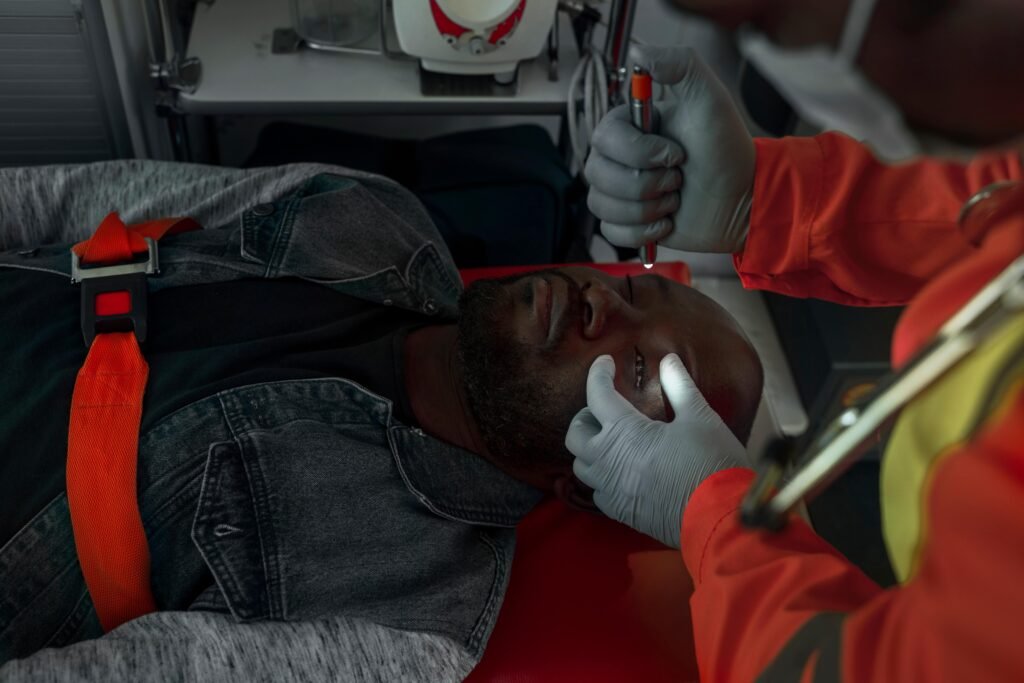
Nobody builds a safety plan around 4 AM. The risk assessments get written during business hours by people who go home at 5 PM. Training happens in the morning. Supervisors are present for the day shift handover. By the time the building goes quiet and the overnight team is running on skeleton staff, most of the formal safety infrastructure has already clocked out.
Night shift and occupational accidents are linked through a mechanism that is biological, structural, and entirely predictable. Most overnight workers are managing that risk without being told what it is or when it peaks. This article names both.
What Does the Research Say About Night Shift and Occupational Accidents?
The headline figure comes from OSHA and it is not subtle. Injury rates for night shift workers run up to 30 percent higher than day shifts. NIOSH puts the increase in accident and error risk at up to 28 percent for overnight schedules compared with standard daytime hours. OSHA data on 12-hour shifts raises that further, with accident and injury rates 37 percent greater than standard daytime hours. A 37 percent higher injury rate is not a rounding error. It is a different kind of workplace.
The most recent and specific study came out of the Scandinavian Journal of Work, Environment and Health in early 2026. Researchers combined objective working-time register data with retrospective survey responses from 1,195 Norwegian healthcare workers and found that night shift frequency was significantly associated with higher rates of work-related accidents, involuntary dozing at work, and dozing during the commute home. The two strongest structural predictors of accident risk were quick returns, meaning fewer than eleven hours between shifts, and overall night shift frequency. These are scheduling decisions made by rosters, not personal failings of individual workers.
The lethality dimension of the night shift and occupational accidents problem is harder to dismiss. A 2023 Brazilian national case-control study found that night-time accidents were 65 percent more lethal than daytime incidents. The same accident, occurring at night, is significantly more likely to kill. Reduced staffing, slower emergency response, and the physiological impairment the overnight hours produce in every worker, regardless of experience or fitness, all compound into a consequence that daytime equivalents simply do not carry at the same rate.
Why Are Night Shift Workers More Likely to Have Accidents?
The night shift and occupational accidents connection has nothing to do with carelessness. It runs through a biological low point that every human body reaches in the early morning hours, a window during which the body is physiologically least equipped to perform the tasks most workers are expected to complete without incident.
The circadian nadir sits between approximately 2 and 6 AM. Core temperature is at its lowest. Melatonin production is at its peak. Alertness is suppressed and reaction time slows in ways that are measurable in laboratory conditions and visible, in retrospect, in accident records. WorkSafe New Zealand places the lowest level of human functioning between 3 and 5 AM. What that looks like in practice: slower reactions when a forklift approaches from the left. Reduced peripheral awareness at a blind corner. Microsleeps lasting two or three seconds that vanish from memory immediately and never make it into an incident report.
Researchers examining the mechanisms behind overnight accidents identify extended wakefulness combined with working through the circadian alertness trough around 4 to 5 AM as the primary driver. A worker who started at 10 PM and is still working at 4 AM has been awake for roughly eighteen hours while also hitting the biological low point of the daily cycle. The fatigue from prolonged wakefulness and the circadian suppression of alertness are operating simultaneously, and neither is obvious to the worker experiencing them because impairment at this level affects metacognition, the capacity to accurately assess how impaired you are.
Research from the Institute for Work and Health found that the increase in work injury during overnight hours is not explained by the nature of the work but by the time of day, with injury risk elevated at night across all occupational categories after controlling for task type. A data entry operator at 4 AM is statistically more likely to make a consequential error than a construction worker at 10 AM. The schedule is doing this, not the job.
When During a Night Shift Does Accident Risk Peak?
The risk does not distribute evenly across a shift. It follows the circadian alertness curve, and knowing where the peaks fall changes how workers and employers think about where to concentrate protective attention.
The opening two hours of a night shift generally carry lower accident risk than what follows. Workers arrive with accumulated sleep pressure but still-reasonable alertness, and the circadian suppression has not yet reached its worst. Around midnight to 1 AM, a secondary dip appears in the first break period as re-engagement after rest requires overcoming a brief alertness drop.
The danger window is 2 to 6 AM.
This is when the circadian nadir coincides with maximum accumulated wakefulness, minimum supervisor presence, and minimum staffing. In healthcare settings medication errors cluster here. In industrial settings machinery accidents concentrate in these hours. In transportation the crash data is densest in this window. The 2026 SJWEH study confirmed that higher night shift frequency correlated with higher rates of involuntary dozing at work, with dozing functioning as both a safety incident and, when it occurs in a safe context, a partial protective response to accumulated fatigue.
A third risk period emerges in the final hour before handover. Workers who navigated the circadian nadir successfully may relax vigilance as the shift end approaches. Physical activity increases during handover preparation and injury risk rises at the exact moment concentration is most depleted.
Which Workers Face the Highest Night Shift and Occupational Accidents Risk?
Not all overnight workers carry identical risk. The variables that amplify night shift accident risk are specific and largely predictable before any accident occurs.
Quick return scheduling stands out as the most significant modifiable structural factor. The 2026 SJWEH study found that quick returns of fewer than eleven hours between shifts were independently associated with higher work-related accident rates, with the researchers specifically noting heightened risk for both employees and patients in healthcare settings with frequent night shifts. A worker returning to a night shift after fewer than eleven hours off arrives already carrying a sleep debt that amplifies the circadian impairment waiting for them in the early morning hours.
Rotating shift workers carry compounded risk compared to permanent night workers. Schedules that switch regularly between day and night prevent meaningful circadian adaptation, so workers arrive at each night shift with a biological system still partially oriented toward daytime activity. Permanent night workers, despite their own significant accident risk, have at least partial adaptation that moderates the severity of the 4 AM nadir compared to a rotating worker encountering it again after three days on days.
Healthcare workers face a specific additional exposure. A 2025 cross-sectional study of 348 nurses across five hospitals in Ecuador found that overnight shift schedules were significantly associated with needlestick and sharps injuries, with insomnia and sleepiness symptoms mediating the relationship between schedule and injury rate. Needlestick injuries carry potential exposure to HIV, hepatitis B, and hepatitis C, making them among the highest-consequence occupational accidents in any clinical setting. The 2026 SJWEH data confirms that in healthcare, night shift frequency correlates independently with accidents causing harm to the worker, to patients, and to equipment, three separate accident categories operating under the same underlying fatigue mechanism.
The elevated accident risk at night applies across all occupational groups, including professional and managerial roles. A biology operating at its lowest functional point does not make exceptions for job titles.

What Dozing Off at Work Actually Means for Night Shift Accident Risk
The 2026 SJWEH study drew an important distinction: while dozing off at work can pose risks for negligence or accidents, it can also serve a rejuvenating function that enhances subsequent alertness and performance, potentially reducing fatigue-related accident risk. That nuance is worth holding.
A microsleep of two to thirty seconds occurring at a desk during a quiet administrative stretch is a different safety event from the same duration occurring while operating a forklift, handling sharps, or monitoring a patient in critical care. The accident risk depends entirely on what the worker is doing when the lapse occurs. In environments where brief unplanned rest during low-activity periods is physiologically safe, the event may be genuinely protective. In environments where a two-second loss of consciousness has irreversible consequences, the same event is a near-miss.
Near-misses are the part of the night shift and occupational accidents problem that most safety systems are structurally designed to miss. Events that never enter an incident report, a microsleep behind the wheel of an order picker, a moment of reduced peripheral awareness at a blind corner, represent risk that most safety managers do not see until it produces an outcome that cannot be explained away.
The incidents that do not get reported are the ones that predict the incidents that do.
What Can Night Shift Workers and Employers Do About Occupational Accidents Risk?
The night shift and occupational accidents risk responds to specific interventions at both individual and employer level. These are not aspirational suggestions. Several have quantified safety effects that the research documents.
Treat the pre-shift nap as a safety measure
For workers with access to rest before a night shift, a planned nap of around 90 minutes taken in the early afternoon, ending at least two hours before the shift starts, produces measurable alertness improvements that carry through the overnight hours. A worker who arrives having banked ninety minutes of recent sleep is operating with a meaningfully different fatigue profile from one who has been awake since morning, with direct implications for accident risk in the 2 to 6 AM window. The complete pre-shift alertness framework is in the guide to how to stay awake on night shift.
Allow and structure in-shift rest breaks
Facilities that permit structured rest during overnight shifts are supporting an evidence-based safety measure. A 2025 systematic review found that scheduled napping was among the most consistently effective interventions for reducing fatigue and improving alertness in night shift healthcare workers. Under twenty minutes avoids sleep inertia on waking. Ninety minutes allows a full sleep cycle. Anything between those two points risks waking from deep sleep, which produces a grogginess that temporarily worsens rather than improves performance. The napping evidence and practical protocol are in the guide to napping on night shift.
Blue light in the workplace is an engineering safety control
Safe Work Australia research identifies high-spectrum blue light at 460 to 490 nanometers as reducing drowsiness by 31 percent during night shifts, outperforming administrative controls including hour limits in the studies examined. Bright blue-enriched lighting during the first half of an overnight shift actively counters the circadian suppression that peaks at 4 AM, without eliminating it. For environments where lighting can be adjusted, this is one of the lowest-cost safety interventions available with a documented effect size.
Forward rotation is not optional if the evidence matters
Safe Work Australia research confirms that forward-rotating schedules, moving workers from nights to evenings to mornings rather than the reverse, reduce accumulated sleep deficit by 40 percent compared to backward rotation. For any operation rotating workers between shifts, the direction of that rotation carries a 40 percent safety margin. Backward rotation, which many workers have imposed on them without explanation, produces measurably more accumulated fatigue and higher accident risk than the alternative.
Eleven hours between shifts is a safety standard, not a scheduling guideline
The 2026 SJWEH research establishes quick returns, shifts beginning fewer than eleven hours after the previous one ended, as an independent predictor of work-related accidents in healthcare workers. The European Working Time Directive mandates eleven hours of rest between working periods. Many healthcare rosters violate this routinely through quick return scheduling. Workers whose rotas include quick returns are working under conditions the research identifies as independently associated with higher accident rates, and raising that concern through occupational health channels or workforce safety reporting is a legitimate workplace safety action with research behind it.
Night shift and occupational accidents follow a pattern that has been studied, quantified, and documented across multiple countries and industries. The 4 AM danger window is not a mystery. The accident risk attached to quick returns is not invisible. The safety value of pre-shift naps, structured in-shift rest, forward rotation, and blue light management is supported by evidence that most workers were never given access to. Workplaces that have treated elevated overnight injury rates as an accepted cost of running a 24-hour operation have done so in the absence of that evidence. The evidence now exists.
What safety practice has made the biggest difference to your overnight shift? Share it in the comments.